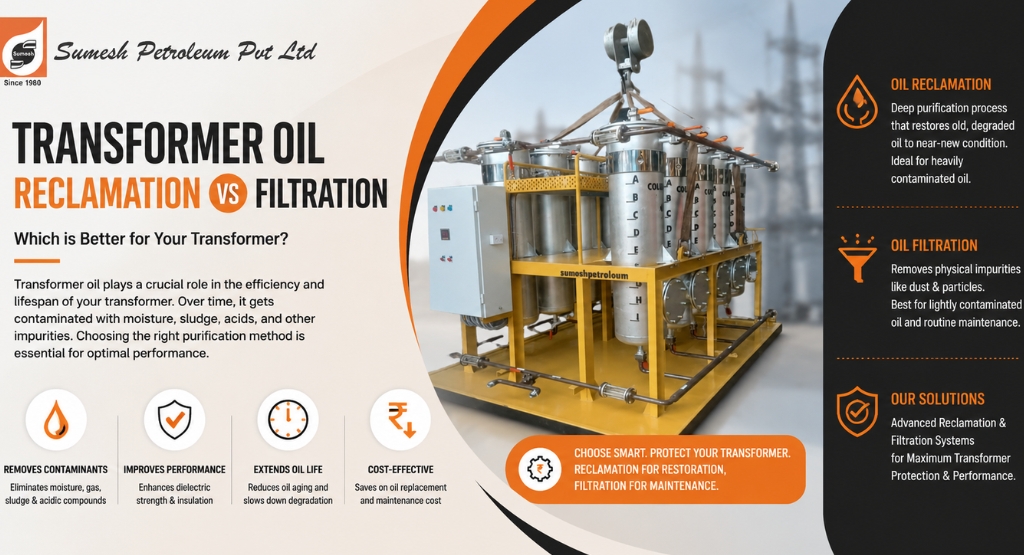
Transformer Oil Reclamation vs Filtration: What Power Utilities Should Know
Power transformers are among the most critical assets in any electrical network. Yet many utilities continue to face unexpected transformer failures, rising maintenance costs, and declining insulation performance due to degraded transformer oil.
When transformer oil quality drops, utilities usually consider two options: filtration or reclamation. While both processes improve oil condition, they are not the same. Understanding the difference between transformer oil reclamation vs filtration can help power utilities extend transformer life, reduce downtime, and improve operational reliability.
At Sumesh Petroleum Pvt Ltd, industries and utilities rely on advanced oil treatment technologies to restore insulating oil performance while minimizing operational risks and replacement costs.
What Is Transformer Oil Filtration?
Transformer oil filtration is the process of removing contaminants such as moisture, sludge particles, gases, and suspended impurities from transformer oil.
The process typically uses:
- Vacuum dehydration
- Mechanical filtration
- Degassing systems
- Fine particulate filters
Filtration improves oil cleanliness and dielectric strength, making it suitable for continued transformer operation.
What Does Oil Filtration Do?
Transformer oil filtration removes physical contaminants and moisture from insulating oil to improve dielectric strength and operational safety. However, it does not restore chemically degraded oil properties.
What Is Transformer Oil Reclamation?
Transformer oil reclamation is a deeper restoration process that not only removes contaminants but also regenerates chemically deteriorated oil.
An advanced oil regeneration system uses adsorbents like Fuller’s Earth or activated clay to remove:
- Acids
- Oxidation s
- Sludge compounds
- Dissolved decay bys
- Aging contaminants
This process restores the oil closer to its original properties and significantly extends transformer life.
Transformer Oil Reclamation vs Filtration: Key Differences
1. Purpose of the Process
Oil Filtration
Focused on cleaning oil physically.
Oil Reclamation
Focused on restoring oil chemically and physically.
2. Treatment Depth
| Feature | Oil Filtration | Oil Reclamation |
| Moisture Removal | Yes | Yes |
| Gas Removal | Yes | Yes |
| Sludge Removal | Partial | Extensive |
| Acid Removal | Limited | High |
| Oil Restoration |
No |
Yes |
| Extends Oil Life | Moderate | Significant |
3. Transformer Condition Suitability
Filtration Works Best For:
- Routine maintenance
- Slightly contaminated oil
- Preventive servicing
- New or moderately aged transformers
Reclamation Works Best For:
- Highly aged transformers
- Oxidized oil conditions
- High acidity levels
- Sludge formation
- Critical utility transformers
Why Power Utilities Prefer Transformer Oil Reclamation
Many utilities initially choose filtration because it is faster and less expensive. However, filtration alone may not solve deeper oil degradation problems.
When oxidation and acidity increase, the transformer insulation system starts deteriorating internally. In such cases, transformer oil restoration becomes essential.
Major Benefits of Reclamation
Longer Transformer Life
Restored oil reduces insulation stress and slows aging.
Lower Replacement Costs
Reclamation delays costly transformer replacement projects.
Improved Dielectric Strength
Cleaner and chemically stable oil improves insulation reliability.
Reduced Downtime
Utilities avoid unplanned shutdowns caused by insulation failure.
Better Environmental Sustainability
Reusing oil minimizes waste disposal and reduces environmental impact.
How an Insulating Oil Reclamation Plant Works
An insulating oil reclamation plant combines filtration and chemical regeneration technologies into one integrated process.
Typical stages include:
- Pre-filtration
- Heating and dehydration
- Vacuum degassing
- Adsorbent regeneration
- Fine filtration
- Oil quality testing
The result is oil with significantly improved:
- Interfacial tension
- Acidity levels
- Color
- Breakdown voltage
- Oxidation stability
When Should Utilities Choose Filtration Instead of Reclamation?
Filtration is still valuable in many operating environments.
Best Situations for Filtration
- Regular preventive maintenance
- Low moisture contamination
- Transformers with healthy oil chemistry
- Temporary maintenance support
- Newly commissioned equipment
Utilities often use filtration as part of scheduled maintenance programs.
When Is Transformer Oil Reclamation the Better Choice?
Utilities should consider transformer oil reclamation when laboratory testing reveals:
- High acidity
- Low interfacial tension
- Darkened oil
- Sludge accumulation
- Poor dielectric strength
- Oxidation instability
Ignoring these warning signs can accelerate paper insulation failure inside the transformer.
Common Mistakes Utilities Make
Delaying Oil Testing
Without periodic oil analysis, utilities often detect degradation too late.
Relying Only on Filtration
Filtration alone cannot reverse chemical aging.
Ignoring Sludge Formation
Sludge blocks cooling pathways and increases operating temperature.
Choosing Low-Quality Service Providers
Improper reclamation processes can damage transformer performance instead of improving it.
Expert Insight: Why Oil Chemistry Matters
Many transformer failures are linked not to external faults, but to gradual insulation deterioration caused by degraded oil chemistry.
Experienced utility engineers increasingly prioritize transformer oil restoration because replacing a large power transformer is far more expensive than restoring oil condition early.
Companies like Sumesh Petroleum Pvt Ltd provide reliable oil treatment solutions designed for long-term transformer protection, operational stability, and customized maintenance requirements.
How to Select the Right Oil Treatment Solution
Choose Filtration If:
- Oil is relatively healthy
- You need preventive maintenance
- Contamination is mainly moisture or particles
Choose Reclamation If:
- Oil shows chemical aging
- Acidity is increasing
- Transformer insulation is at risk
- You want maximum asset life extension
The best approach often combines routine filtration with periodic reclamation based on oil analysis reports.
Why Utilities Trust Advanced Oil Regeneration Systems
Modern oil regeneration systems are designed for:
- Continuous operation
- High-capacity transformers
- On-site servicing
- Minimal downtime
- Better oil recovery efficiency
This makes reclamation increasingly popular among:
- Power generation plants
- Transmission utilities
- Industrial substations
- Renewable energy facilities
- Heavy manufacturing industries

